

Situational writing is one of the most predictable parts of the O-Level English paper, and that is good news. Unlike the open-ended essay, it rewards a clear method: understand the task, use the information you are given, and write in the right format and tone. Once you know the O-Level English situational writing requirements, you can walk into the exam with a plan rather than a blank page.
This guide breaks down what situational writing tests, the exact structure to follow, and the practical habits that turn a safe pass into a strong score.
Quick answer: O-Level situational writing asks you to write a text, such as an email, article, letter or speech, for a specific purpose and audience, using the points provided in the question. You are marked on task fulfilment (covering every point correctly) and on language, so accuracy of tonematters as much as grammar.
What Is Situational Writing In O-Level English?
Situational writing is a functional writing task in Paper 1. You are given a real-world scenario, a purpose, an audience, and a set of points or a visual text to work from. Your job is to respond appropriately, for example by writing an email to a principal, a report for a committee, or a speech for your schoolmates.
It is not about being creative for its own sake. Examiners want to see that you can communicate clearly and appropriately in a real situation, which is exactly the skill the task is designed to test.
The O-Level Situational Writing Approach Format
Every situational writing answer follows the same underlying shape, whatever the text type. Get this structure right and the rest becomes far easier.
- Identify purpose, audience and format: Before you write a word, note why you are writing, who you are writing to, and what text type is required. These three decisions control your tone and layout.
- Open appropriately: Start with the correct greeting or heading for the format, whether that is a salutation for a letter, a subject line for an email, or a title for a report.
- Cover every point: Work through all the bullet points in the question, expanding each one into full, developed sentences rather than copying them.
- Close correctly: End with the sign-off that matches the format and register, such as a formal closing for a report or a warm one for a friendly email.
Match Your Tone To The Audience
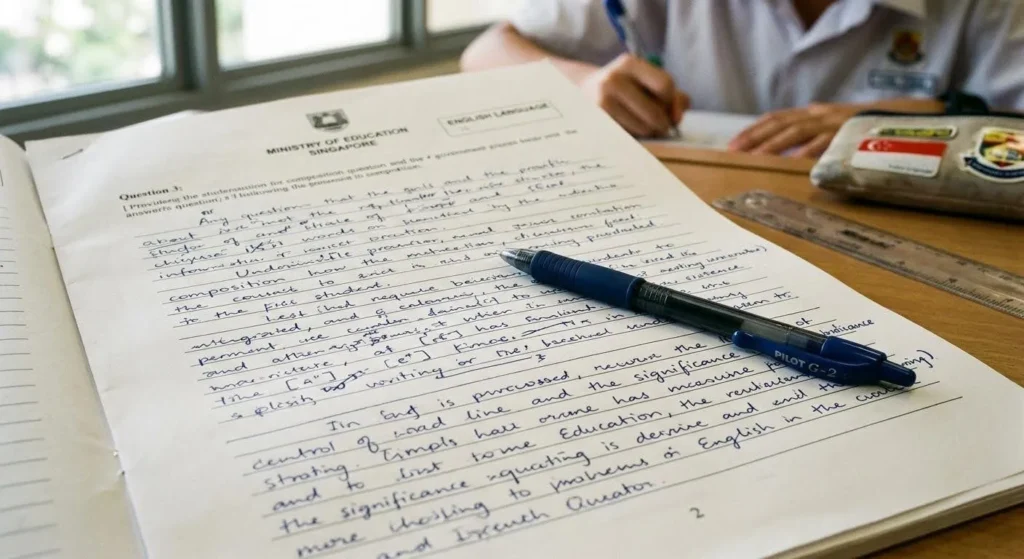
Register, the level of formality, is where many students quietly lose marks. Writing to a principal is not the same as writing to a family member, and the examiner is watching for that difference.
- Formal audience: For a principal, an official or a committee, use full sentences, no contractions, and a polite, measured tone.
- Semi-formal or friendly audience: For a peer or a younger student, you can warm up the tone while still staying clear and organised.
- Stay consistent: Pick the right register at the start and hold it all the way to your sign-off. A sudden slip into slang undoes an otherwise strong answer.
Use The Given Points, Do Not Just Copy Them
The points in the question are your content checklist, but lifting them word for word will cap your marks. The skill is to develop each point into your own clear sentences, adding a reason, an example or a consequence so it reads naturally.
A useful habit is to tick each point as you address it. Missing even one is the most common reason strong writers lose task-fulfilment marks they should have kept.
Common Mistakes That Cost Marks
- Misreading the task: Not identifying the purpose or audience before you start, which sends your response down the wrong path.
- Ignoring the audience: A casual tone in a formal task, or vice versa, is an easy and avoidable loss.
- Dropping points: Skipping a bullet point, or covering it too briefly, leaves marks on the table.
- Rushing the language: Careless tense, subject-verb agreement and punctuation slips add up. Leave two minutes to proofread.
How To Practise Situational Writing Effectively
The fastest way to improve is deliberate, marked practice rather than reading model answers alone. Work through past-year scenarios, then check your response against the purpose, audience, format and points. Strong reading skills feed directly into this, which is why techniques from visual text comprehension carry over so well, since both tasks reward reading the question closely before you respond.
If writing is a recurring weak spot, targeted help makes a real difference. Our secondary English tuition programme drills exactly these functional writing skills, and pairs them with the wider paper so students see how English tuition ties reading, writing and oral together.
Getting Situational Writing Right
Situational writing rewards preparation more than talent. When you know the requirements, read the task carefully, match your tone to the audience and cover every point, you remove almost all the guesswork from this section of the paper.
If you find that your child would benefit from structured, exam-focused guidance, do contact DO Applied Learning by Epoch Talent Academy, which helps Singapore students build these skills step by step. Get in touch with us to find out how we can support their O-Level English journey.
Want your teen to score higher in O-Level English? Speak to our team about a complimentary trial lesson today.
Frequently Asked Questions About O-Level Situational Writing
What is O-Level English situational writing about?
Situational writing asks you to write a text such as an email, letter, report or speech for a given purpose and audience, using the points provided. You must open and close with the context in mind, cover every point, and keep a consistent, appropriate tone throughout.
How is O-Level situational writing marked?
It is marked on two areas: task fulfilment, meaning how well you cover every required point in the correct format and tone, and language, meaning the accuracy and clarity of your grammar, vocabulary and punctuation.
How long should a situational writing answer be?
Aim to cover every point fully rather than hitting a fixed word count. A focused response that develops each point in clear sentences, usually a few well-organised paragraphs, scores better than a long answer that rambles or repeats itself.
What is the most common situational writing mistake?
The most common mistake is missing or under-developing one of the given points, followed closely by using the wrong tone for the audience. Reading the task carefully and ticking off each point as you write prevents both.
How can my child improve at situational writing?
Regular marked practice with past-year scenarios is the most effective method, ideally with feedback on format, tone and task fulfilment. Structured tuition can accelerate this by targeting the specific habits that cost marks.