
Quick answer: Many PSLE English comprehension mistakes occur because students misinterpret what a question requires, select the wrong evidence or express their answers imprecisely. At DO Applied Learning, we teach six common question categories to help students recognise what is being tested and select an appropriate answering method.
What PSLE Comprehension Is Really Testing
Reading and understanding a passage is only the beginning.
In PSLE English Paper 2, comprehension questions assess students’ ability to understand information, interpret meaning and make judgements based on what they have read.
A student may understand the overall story but still struggle to answer individual questions accurately.
For example, a child might correctly identify what a character did but fail to explain why the character behaved that way.
Another might locate the relevant sentence but include unnecessary or contradictory information in the answer.
Understanding the passage and answering the question precisely are related, but they are not identical skills.
That is why we teach students to identify what each question requires before deciding how to answer it.
The six categories below form a practical teaching framework. They are not an official classification issued by SEAB, and some questions may involve more than one skill.
The 6 Common PSLE Comprehension Question Types

1. Literal Questions: Finding Explicit Information
Literal questions ask students to retrieve information directly stated in the passage.
They often begin with words such as who, what, when and where.
Example
Passage: John placed his schoolbag beneath the bench before running towards the playground.
Question: Where did John leave his schoolbag?
Answer: John left his schoolbag beneath the bench.
How to answer: Identify the information requested, locate the relevant detail and provide an accurate answer without unnecessary information.
Common mistake: Copying an entire sentence or paragraph when only one detail is required.
Students should also ensure that pronouns in their answers have clear references. However, repeating a noun is unnecessary when the reference is already unambiguous.
2. Vocabulary Questions: Understanding Words in Context
Vocabulary questions assess whether students understand the meaning of a word or expression as it is used in a particular passage.
Two common tasks require different approaches.
Type A: Identifying a word or phrase from the passage
Example:
Passage: Despite several setbacks, Sarah remained determined to complete the race.
Question: Which word in the passage means that Sarah was firm in her decision to succeed?
Answer: Determined.
The student must locate the word that matches the meaning described.
Type B: Explaining or supplying a suitable word or description
Example:
Question: What does Sarah’s decision to continue despite several setbacks suggest about her character?
Answer: She was persevering.
Here, the student must interpret Sarah’s behaviour and provide an appropriate description.
Common mistake: Choosing a word that seems impressive but does not accurately match the meaning or context.
The important distinction is whether the question requires students to retrieve wording from the passage, explain its meaning or supply an appropriate description.
3. Sequencing Questions: Understanding the Order of Events
Sequencing questions assess whether students can identify when events occurred.
The challenge is that the order in which events are described may differ from the order in which they happened.
Example
Passage: As John entered the classroom, he remembered leaving his homework on the dining table that morning. He had packed his schoolbag the previous night.
Question: Which event happened first?
Answer: John packed his schoolbag.
Although the passage mentions John entering the classroom first, packing his schoolbag was the earliest event chronologically.
How to answer: Identify time expressions, distinguish memories from present events and arrange events according to when they actually occurred.
Common mistake: Assuming that the first event mentioned in the passage must also be the first event chronologically.
4. True or False Questions: Checking Every Detail
True or false questions assess whether statements agree with the information provided in the passage.
Students must examine the entire statement rather than recognising only a familiar word or detail.
Example
Passage: Mary visited the library on Tuesday and borrowed two books about marine animals.
Statement: Mary visited the library on Wednesday to borrow three books about marine animals.
Answer: False.
The statement contains several inaccuracies, even though Mary did visit the library to borrow books about marine animals.
How to answer: Break the statement into its important details and verify each one against the passage.
A statement should only be considered true when all its relevant claims are supported by the text.
Common mistake: Reading the first half of a statement, recognising familiar information and selecting “True” without checking the remaining details.
Where the question requires evidence or an explanation, students must also provide the supporting information rather than stopping at “True” or “False”.
5. Inferential Questions: Reading Between the Lines
Inferential questions require students to draw conclusions from information that may not be stated directly.
They assess whether students can interpret a character’s feelings, motivations, attitudes or circumstances using clues from the passage.
Example
Passage: When Mrs Tan asked who had broken the vase, James lowered his head and avoided her gaze.
Question: How was James probably feeling?
Answer: James was probably feeling guilty.
The passage does not explicitly state that James felt guilty. However, his reaction provides a reasonable clue.
How to answer: Identify the relevant clues, consider what they suggest and draw a conclusion that is supported by the passage.
Where the question asks students to explain their inference, they should include the relevant evidence.
Common mistake: Making assumptions based on personal experience rather than information from the passage.
An inference is not a guess. It is a conclusion supported by textual evidence.
6. Cause and Effect Questions: Explaining Why Something Happened
Cause and effect questions assess whether students understand the relationship between an event and its consequences.
The cause explains why something happened.
The effect describes what happened as a result.
Example
Passage: Heavy rain flooded the school field, forcing the organisers to cancel the football match.
Question A: Why was the football match cancelled?
Answer: The football match was cancelled because heavy rain had flooded the school field.
Question B: What happened as a result of the heavy rain?
Answer: The school field was flooded, and the organisers cancelled the football match.
Notice that the two questions refer to the same event but demand different information.
How to answer: Identify the cause and the effect, then determine which part of the relationship the question requires.
Common mistake: Describing what happened when the question asks why it happened, or explaining the cause when the question asks for the consequence.
What About Evaluative Questions?
The six categories above provide a useful starting point, but they do not cover every possible comprehension demand.
Some questions also require students to evaluate a character’s decision, assess an attitude or justify a judgement using evidence.
For example:
Question: Do you think James acted responsibly? Give a reason for your answer.
A suitable response must address the judgement and provide a defensible reason based on the passage.
Students should therefore avoid applying question-type rules mechanically. The exact wording of the question always takes priority over the category assigned to it.
Three Common Mistakes That Lead to Lost Marks
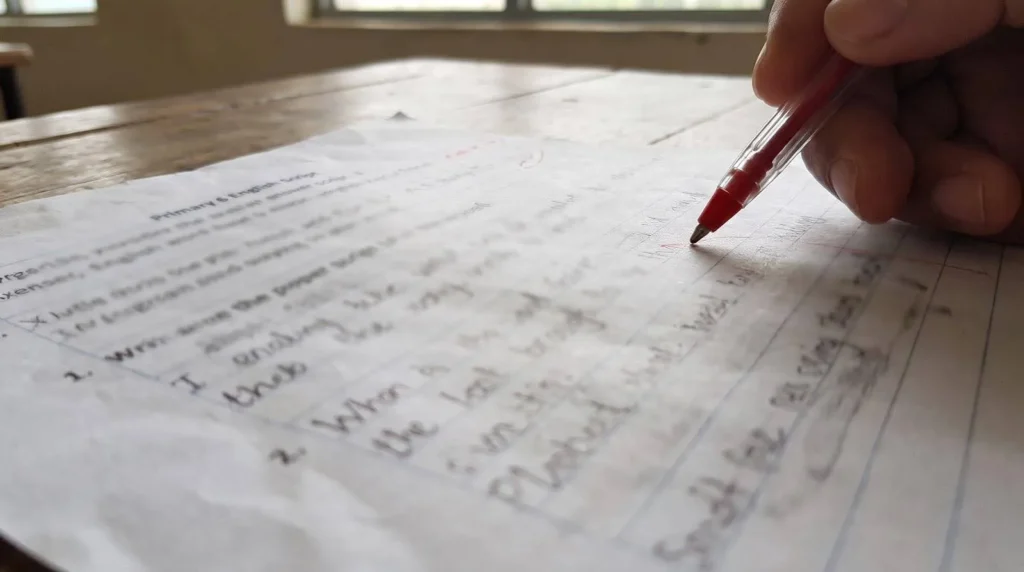
Across different question types, we often look for three recurring weaknesses.
- Answering a different question from the one asked
A student explains what a character did when the question asks why the character did it.
- Selecting incomplete or irrelevant evidence
A student locates the correct paragraph but overlooks the specific detail needed to support the answer.
- Expressing the answer imprecisely
A student understands the intended meaning but produces a response that is ambiguous, incomplete or inconsistent with the passage.
These mistakes may look similar on a marked worksheet, but they do not necessarily share the same cause.
One student may need help interpreting questions. Another may need practice selecting evidence. A third may need help expressing ideas accurately.
That is why simply completing more comprehension passages does not always solve the problem.
How We Teach PSLE English Comprehension

At DO Applied Learning, our approach follows three stages.
Master the Method.
Students learn to recognise what a question requires, identify relevant evidence and select an appropriate answering technique.
Nail the Answer.
Students practise turning their understanding into accurate, complete and concise responses.
Own the Exam.
Students apply these skills to unfamiliar passages, with increasing independence and consistency under examination conditions.
The objective is not simply to help students recognise familiar question types.
It is to help them make the right decisions when the questions are unfamiliar.
This is especially important because examination questions may combine different comprehension skills.
Conclusion: Diagnose the Mistake Before Doing More Practice
When a child loses marks in comprehension, the incorrect answer tells us where the problem appeared.
It does not necessarily tell us why the problem occurred.
Before assigning more practice papers, we should determine whether the difficulty lies in understanding the passage, interpreting the question, selecting evidence or expressing the answer.
Different weaknesses require different interventions.
At DO Applied Learning, our primary English tuition programme focuses on identifying these specific weaknesses and teaching students how to overcome them.
If your child understands the passage but continues to lose comprehension marks, a complimentary English diagnostic session can help identify what needs to change.
Book a complimentary English diagnostic session at our Marine Parade classroom.
No obligation. Just a clearer understanding of your child’s strengths and areas for improvement.
Frequently Asked Questions About PSLE English Comprehension
How Many Question Types Are There in PSLE Comprehension?
There is no official SEAB classification consisting of exactly six question types. At DO Applied Learning, we use six practical categories: literal, vocabulary, sequencing, true or false, inferential, and cause and effect. Students must also be prepared for evaluative questions and questions that combine several skills.
Why Does My Child Lose Marks Even When the Answer Seems Right?
The answer may be incomplete, insufficiently supported, imprecisely expressed or directed at a different question. The best way to identify the issue is to examine both the question and the student’s reasoning rather than simply replacing the answer with a model response.
What Is the Hardest PSLE Comprehension Question Type?
Inferential and evaluative questions can be demanding because students must interpret evidence rather than simply retrieve information. However, the difficulty depends on the passage, the question and the individual student’s strengths.
How Should My Child Practise Comprehension at Home?
Ask your child to attempt a short passage independently. Review incorrect answers by identifying what each question requires, checking the relevant evidence and explaining how the answer should be constructed. Focus subsequent practice on recurring weaknesses rather than merely increasing the number of passages completed.
Should My Child Always Answer in Full Sentences?
In most cases yes. A full sentence makes the reference clear and shows the marker which part of the question is being answered. The exception is a question that asks for a single word or a short phrase, where a brief answer is correct. The rule is clarity, not length.