Most Students Don’t Struggle In Composition Because of Language. They Fall Behind Because of This.
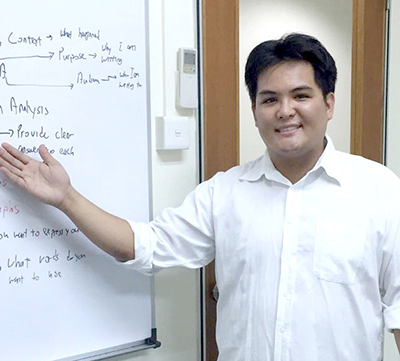
On 1 March 2026, Teacher Daniel Ong, Founder of DO Applied Learning, was invited to lead a sold-out webinar as part of the Copyright School Challenge 2025/26, organised by the Copyright Licensing and Administration Society of Singapore and supported by Singapore Asia Publishers.
The session was fully subscribed. Yet, what stood out was not the turnout.
It was the problem most students still do not realise they have.
The Real Issue: Creative Writing Without Structure
Most students are taught that creative writing is about freedom.
So they:
Write whatever comes to mind
Add “good vocabulary”
Try to make the story more “interesting”
But halfway through, the story falls apart.The ideas drift, then focus weakens, and the conclusion feels rushed.
This happens not because the student lacks ideas, but because there is no structure holding the story together.
What Was Shared During the Session
During the webinar, Teacher Daniel addressed a pattern seen across thousands of scripts.
Students are not struggling because they cannot write.
They are experiencing this because they are not trained to think clearly before they write.
Adding descriptive phrases to a weak story is like painting over cracks in a wall.
The structure underneath is still broken, and under exam pressure, it shows.
Why This Matters for Your Child
This is where most composition programmes fall short.
They focus on:
Vocabulary lists
Model essays
Repeated practice
Yet without a clear structure, students simply repeat the same mistakes.
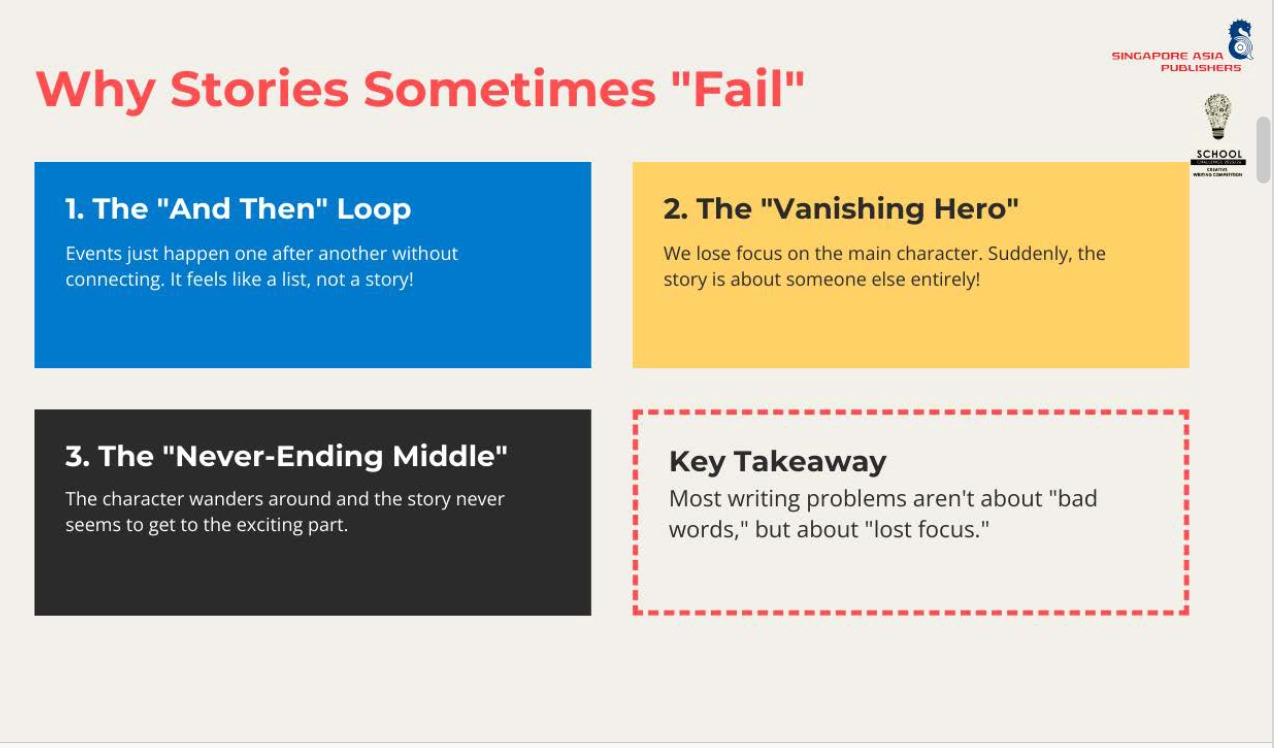
Why Stories Sometimes "Fail"
1. The "And Then" Loop
Events just happen one after another without connecting. It feels like a list, not a story!
2. The "Vanishing Hero"
We lose focus on the main character. Suddenly, the story is about someone else entirely!
3. The "Never-Ending Middle"
The character wanders around and the story never seems to get to the exciting part.
4. Key Takeaway
Most writing problems aren’t about “bad words,” but about “lost focus.”
At DO Applied Learning by Epoch Talent Academy, the focus is different.
Students are trained to:
Build a clear central idea
Develop it step by step
Maintain focus from start to finish
So even when the question changes, their thinking does not break down, as they are taught how to adapt what they already know to fit the new circumstance.
From Guesswork to Control
Being invited to contribute to a national initiative like the Copyright School Challenge 2025/26 reflects a simple reason.
The approach we use works.
That is not because it gives students more to memorise; rather, it removes guesswork.
What You Can Do Next
If your child’s composition marks are inconsistent, this is not an effort issue.
It is a structural issue.
And until that is fixed, practice alone will not lead to improvement.
Start by asking:
Does your child know exactly what their story is about before they begin?
Can they develop one idea clearly, instead of jumping around?
Do they know how to end their story properly under exam pressure?
If the answer is no, the problem is already clear.
Fix It Properly
For parents who want clarity, there are two ways forward.